


EA SPORTS FC™ Mobile Soccer
ELECTRONIC ARTS
I first understood the appeal of EA SPORTS FC™ Mobile Soccer during a shared-device moment: one person wants a quick football match, another wants to check a team, and the phone is already the household’s most convenient screen. This is a sports game that can fit into short sessions, but it also has enough depth to become a regular hobby. I found it easy to start with a familiar club or player, while the broader experience asks for more attention than a simple arcade kickabout.
That balance is important for families and friends sharing a phone or tablet. The game is free to download, developed by ELECTRONIC ARTS, and carries an Everyone age rating. Those points make it approachable, but they do not mean every part of the experience is equally suitable for every household routine. The main questions are practical ones: who is playing, whose account is being used, how spending is handled, and whether other people can use the device without disturbing progress.
How the game works in a shared household
In my experience, the best shared-use scenario is a short, clearly defined session. A child might play a few matches after homework, while a parent uses the same device later for something else. Someone who follows Premier League, UCL, or LALIGA football can also enjoy browsing and building around recognizable stars rather than learning an unfamiliar fictional sport.
Related News

Basketball Stars: Multiplayer Dominates Mobile Sports Gaming

EA SPORTS FC Mobile Is Excellent Football, but Not for Every Player

The Secret Behind Trivia Crack's Addictive Question Wheel
The game’s strength here is its flexible scale. A player can treat it as a quick distraction, but a more committed fan can spend longer working through team decisions and match preparation. That makes it more interesting than a basic penalty-kick game, although it also creates a temptation to keep checking progress. If your household wants a game that is always finished in a few minutes, this may feel more involved than necessary.
For a shared device, I would agree on a simple routine before installing it. Decide whether the game belongs to one person or whether everyone is taking turns with the same profile. That sounds obvious, but sports games become personal quickly: a changed lineup, an altered squad, or a spent item can feel like someone has interfered with another player’s work.
Related News

Why WhatsApp Messenger Still Makes Everyday Communication Feel Easy

Jurassic World: The Game Is the Better Dino Tycoon for Strategic Players

Threads in Real Life: Who Should Join, Lurk, or Leave

How SHEIN Turned Shopping Into an Endless Content Feed

How to Make Fortnite Feel Smarter on Mobile

Should You Switch to Microsoft Outlook on Mobile?
The most useful household rule is to treat one in-game profile as one person’s space. If several people play on the same profile, coordination matters more than the game’s football mechanics. Keep a verbal agreement about who changes the team, who plays competitive matches, and who is allowed to use any paid currency or purchase option.
Starting without creating unnecessary confusion
The first session should be used to learn the basic rhythm rather than rushing into every available activity. I recommend letting the main player complete the early guidance at their own pace, then showing other household members how to reach the parts they are allowed to use. Passing the phone around during setup can lead to accidental selections, especially when a younger player is excited to tap through menus.
It is also worth deciding where the game sits on the device. If the phone is used for school, work, or communication, a large game can become a distraction simply because it is always visible. I would keep play times separate from essential device use, particularly when the same handset is needed by several people during the day.
Gallery
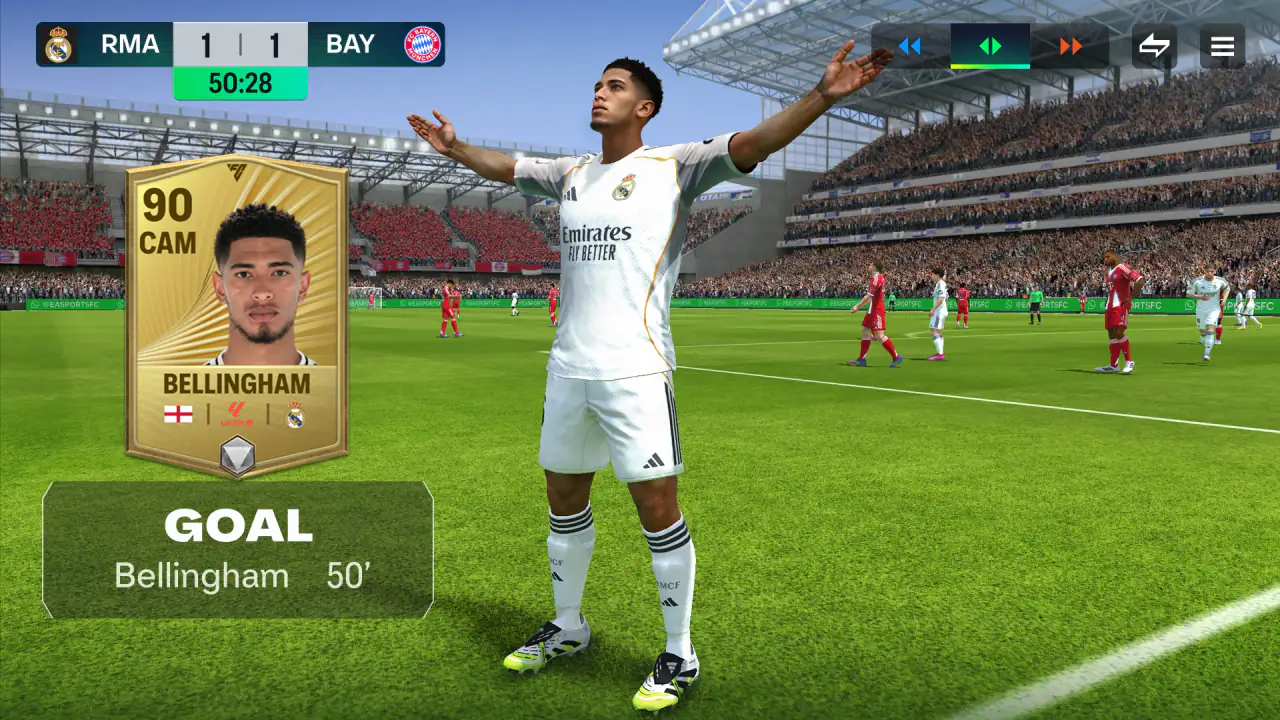
EA SPORTS FC™ Mobile Soccer is free, which lowers the barrier to trying it. However, optional purchases range from $0.39 to $99.99 per item. I would not leave spending decisions to chance on a shared device. The sensible approach is to make the rule explicit: no purchase without the account holder’s permission. That protects both the household budget and the trust between players.
The Everyone rating is helpful when deciding whether the game is broadly suitable for a household, but an age label does not settle every question. A younger player may understand the football action while still needing an adult to explain spending, account ownership, and why another person’s squad should not be changed. I see the rating as a starting point for supervision, not a replacement for it.
Account boundaries matter more than the match itself
One of the less obvious trade-offs is that shared hardware does not automatically make a shared game experience. If two people want separate progress, they should avoid treating the same in-game space as communal storage. One person may be interested in collecting and improving a squad, while another only wants to play matches. Their priorities can conflict even when both enjoy football.
My practical advice is to assign responsibility before the first serious session. The person who owns the profile should make decisions about squad changes, purchases, and any connection or sign-in choices. A second player can still enjoy matches, but should ask before changing anything permanent. This is especially important when a child and an adult use the same device, because the adult may be responsible for payment details while the child assumes every visible option is part of the free game.
For households with more than one enthusiastic player, separate devices or clearly separated profiles are preferable if available. I would choose that arrangement over constant negotiation. The game is much more enjoyable when a player can experiment with a team without worrying that another person will undo the decision later.
There is also a social boundary. A younger player may want to imitate a parent’s team choices, while an older sibling may be tempted to “improve” the squad. Helping is fine, but taking over removes the learning part of the game. I found that explaining why a change was made is more useful than silently making it. That turns shared play into coaching rather than control.
Coordinating short sessions and longer football habits
A realistic household routine might look like this: one player gets a short turn before dinner, the device returns to common use, and a longer session happens later when nobody needs the phone. That arrangement works better than allowing the game to interrupt every spare moment. Because the experience combines matches with ongoing team attention, it can encourage “just one more check” even when the player originally intended to stop.
I would use a visible turn-taking agreement for younger players. It does not need to be complicated. A simple order of play and a clear stopping point can prevent arguments, especially when one person is in the middle of a match. The important detail is to avoid ending another player’s session by force unless necessary; football games are more frustrating to share when someone repeatedly loses control of the device at an awkward moment.
For adults sharing with children, cooperation works best when the adult joins the game occasionally instead of acting only as a gatekeeper. Playing a match together makes it easier to discuss fair use, spending, and sportsmanship naturally. It also reveals whether the child enjoys the actual football or is mainly attracted to the progression and collection side.
Players should also agree on what counts as a private decision. Changing a formation may be harmless in a casual shared session, but using a valuable item or spending money is different. I would separate ordinary play from account management and require permission for the latter. This distinction is more useful than a vague instruction to “be careful.”
Where it stands beside other football games
Compared with a simple offline football game, this title feels more connected to the wider football world and more focused on recognizable competitions and stars. That is a clear advantage for fans who want the identity of real-world football rather than a generic match with anonymous teams. The trade-off is that it may demand more menu time and ongoing attention than someone seeking a pure, immediate arcade experience expects.
Compared with a full console-style football simulation, playing on a phone is more convenient and easier to fit around daily life. I can pick it up without setting up a television, which is valuable in a busy household. At the same time, a mobile format is not the best choice for someone who wants the deepest controller-based simulation, a large-screen presentation, or a long uninterrupted session with no shared-device concerns.
It also differs from a manager-only game. Here, the attraction is not just choosing tactics from a distance; the player wants the feeling of participating in football matches. If your favorite part of the sport is transfers, statistics, and planning rather than playing, a dedicated management alternative may suit you better. I would choose this game for a fan who wants both team involvement and match action, not for someone who wants administration alone.
The game’s broad popularity gives it a useful social advantage. It has an average rating of 4.6 from around 21 million ratings, and it has passed 500 million installs. Those figures suggest a very large audience, but they do not guarantee that every player will enjoy the same style. A crowded, familiar game can be a good meeting point for football fans, while a person who prefers quiet, self-contained games may find the broader ecosystem less appealing.
What the current version means for practical use
The current version is 26.1.02, and the game requires Android 6.0 or later. For a household, that means checking the device before planning a shared installation. An older phone may technically meet the operating-system requirement but still feel less comfortable for a modern sports game, especially if the device is already busy with photos, messaging, and other apps.
I would also think about storage and battery habits without assuming every device behaves the same way. A football game is more demanding than a small puzzle title, so a shared phone may need to be charged before a longer session. If the device is also used for emergency calls, school communication, or work, it is better not to let gaming become the reason it is unavailable at the wrong time.
The release date is Oct 10, 2016, but the important point for a new player is not the age of the original release. What matters is that the game remains a current, maintained-style mobile football experience with a present version and a large player base. I would still expect a newcomer to spend time learning the current menus rather than assuming the game works exactly like an older football title they remember.
Another practical question is whether the free entry matches your expectations. You can begin without paying, which is useful for testing the controls and overall rhythm. But the presence of in-app purchases means the household should decide in advance whether the free experience is the complete boundary or merely the starting point. I prefer trying it for several sessions before considering any purchase, because the real question is whether the player enjoys the routine, not whether an item looks attractive on the first day.
Age, trust, and responsible sharing
The Everyone rating makes the game easier to consider for mixed-age households, but the account holder still needs to guide younger players. The most important conversations are not about whether football is appropriate; they are about ownership and permission. A child should know which actions affect the shared profile and which actions may involve real money.
I would explain that free access and optional purchases are separate things. The game costs nothing to start, while individual in-app items can cost from $0.39 up to $99.99. Saying this plainly helps a child understand why tapping a button is not always the same as earning something through play. It also gives adults a natural opportunity to discuss asking first rather than treating every highlighted option as a reward.
Trust works both ways. Adults should not change a child’s team or use their profile as a testing area without asking, and children should not assume that a familiar phone means every account action is theirs to make. Clear boundaries reduce the chance that a small football disagreement becomes a larger household argument.
The game can be a good shared interest when the adult is willing to learn the basics alongside the child. I found that discussing a favorite player or formation creates better cooperation than focusing only on screen time. Still, I would skip it for a household that cannot agree on spending limits or profile ownership. The football may be harmless, but unclear boundaries around a persistent game can create avoidable friction.
Who should choose it, and who should skip it
I recommend this game to football fans who want recognizable competitions and stars in a mobile format, especially if they enjoy improving a team over repeated sessions. It is also a good fit for a shared household that can assign one clear account owner and set predictable turns. The free starting point makes it practical to test before making a longer commitment.
I would be more cautious if you want a completely offline, no-distraction experience, a purely casual game with no ongoing team decisions, or a serious console-level simulation. I would also skip it on a shared device where nobody can agree about purchases and squad changes. In those situations, a simpler football game or a game with a more self-contained structure may be less stressful.
My strongest tip is to judge the game after the novelty of the famous names wears off. Play enough to see whether you enjoy the match flow, the team-building decisions, and the repeated routine. If only one of those parts appeals to you, the experience may feel unbalanced. If all three work together, the game has enough variety to become a reliable football companion.
My household verdict
After spending time with it, I see EA SPORTS FC™ Mobile Soccer as a capable mobile sports game that works particularly well when expectations and account boundaries are clear. It is approachable enough for a younger football fan, recognizable enough for an adult supporter, and flexible enough for short sessions. Its biggest household weakness is not the football itself; it is the possibility of shared-device confusion and uncontrolled spending.
I would install it on a family device only after deciding who owns the profile, when turns happen, and what requires permission. That small amount of planning protects the parts I like most: the immediacy of a match, the connection to major football competitions, and the satisfaction of shaping a team over time.
For me, the final recommendation is straightforward. Choose it if you want a free mobile football game with a large community, familiar stars, and room for both quick play and deeper involvement. Choose something simpler if your priority is a totally private, instant match with no account discussions. In a household that communicates well, this can be a fun shared interest; in one that does not, the same flexibility can quickly become a source of arguments.
FAQs for EA SPORTS FC™ Mobile Soccer
What are the system requirements for EA SPORTS FC™ Mobile Soccer?
EA SPORTS FC™ Mobile Soccer requires a device with Android 6.0 or later, or iOS 11.0 or later. Ensure your device has at least 2GB of RAM for smooth gameplay. It's recommended to have a stable internet connection for downloading updates and accessing online features.
Is EA SPORTS FC™ Mobile Soccer free to play?
Yes, EA SPORTS FC™ Mobile Soccer is free to download and play. However, it offers in-app purchases for items like player packs and special abilities. These purchases can enhance gameplay but are not necessary for enjoying the game. Always monitor in-app purchases to avoid unexpected charges.
How often does EA SPORTS FC™ Mobile Soccer receive updates?
The game regularly receives updates to add new features, players, and events. Updates also include bug fixes and performance improvements. It's advisable to keep the app updated to enjoy the latest content and ensure optimal performance. Check your device settings to enable automatic updates.
Can I play EA SPORTS FC™ Mobile Soccer offline?
EA SPORTS FC™ Mobile Soccer requires an internet connection for most of its features, including online matches and events. Some modes, like practice or basic gameplay, might be available offline, but the full experience is best enjoyed with a stable online connection.
What modes are available in EA SPORTS FC™ Mobile Soccer?
The game offers various modes, including Ultimate Team, where you build and manage your team, and Challenge Mode, which provides weekly tasks. There's also a Career Mode for managing a club over multiple seasons. Each mode offers unique gameplay experiences, catering to different play styles.
Pros
- Realistic graphics enhance gameplay.
- Smooth controls for easy navigation.
- Regular updates with new features.
- Diverse team customization options.
- Offline mode available for practice.
Cons
- In-app purchases can be costly.
- Requires stable internet connection.
- High battery consumption during play.
- Limited free content for beginners.
- Occasional server connection issues.


